
Coordination infrastructure
Resources exist.
Coordination does not.
We design systems and build infrastructure that closes that gap — and we configure it in days, rather than building it over months.
We are a force multiplier for impact.
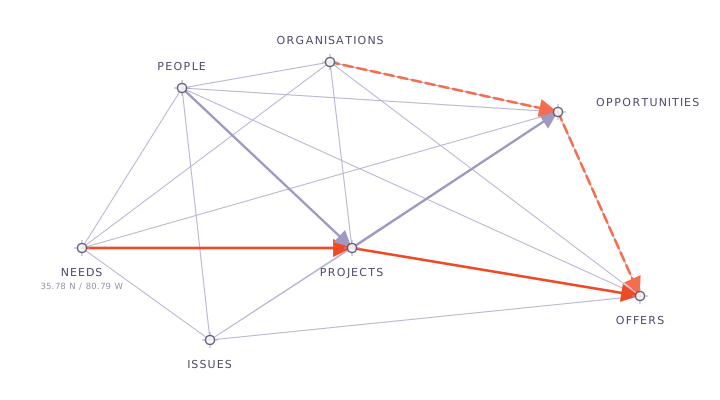
Everything in your ecosystem that could connect.
A need routed to an offer.
A person routed to an opportunity.
An organisation routed to a project.
Three of the routes this platform runs. Many-to-many, in both directions, continuously.
Evidence · North Carolina, 2024–25
North Carolina VOAD ran needs-and-offers matching through Hurricane Helene and Hurricane Milton on infrastructure that was configured, not built. No integration project. No per-seat licensing. No pilot phase.
503
Registered users
226
Organisations
$1.8M
Offers coordinated
$177,140
Value of needs fulfilled
Needs and offers, as North Carolina ran them · reconstructed on the current Innovation Exchange surface
Source · North Carolina VOAD · September 2024 – January 2025. Publishable and independently verifiable. Figures dated at point of extract.
Supporters, funders and clients
Twenty-nine institutions have backed, funded and deployed this work.



◆

◆


Deployments

◆
◆

Inclusive Capital Exchange

Funders and supporters





◆ Appears in two groups — a practice engagement that became a deployment. Logos indicate funding, partnership or deployment, not endorsement of this page.
What we do
A practice that designs systemic coordination, and a platform that runs it.
Most consultancies design a system and hand you a report. Most vendors sell you software and leave. We do the design work, the mapping, the convening, the facilitation, the architecture, and then we have somewhere to put the answer. That is the whole proposition, and it only works because both halves are the same people.
Six people. No account managers — the person facilitating your roundtable is the person who designed the schema.
Half one · The practice
Ecosystem design
Before there is a platform there is a room full of people who do not yet agree. Getting them to agree is the harder half of this work, and it is the half we have been doing for thirty years.
— Impact finance ecosystem design
— Innovation roundtables and multi-stakeholder convening
— Participatory design and facilitation
— Data schema and interoperability architecture
Priced by discussion · per engagement
Half two · The platform
The Innovation Exchange
— Needs-and-offers matching
— Opportunity and submission management
— Project forking with provenance
— Organisation and permission modelling
$0 – $20,000 / year · unlimited users
The cost
Being both is unusual and it makes us harder to categorise in a procurement process. If your framework has a box for software vendor and a box for consultancy, we will sit awkwardly in both. We would rather tell you that now than discover it at contract stage.
The Exchange · The model
Every competing system makes Organisation primary, then attaches people to it. That is why a coordinator who changes employer loses their history, and why the network dissolves each time someone moves. We built it the other way round.
Case studies
One fix is an anecdote. Nine is a pattern.
Crisis response in North Carolina and Ukraine. Refugee resettlement in the United States. Marine conservation in Mexico. Impact finance for BIPOC entrepreneurs. Nine deployments that share nothing except the shape of the problem, and the same infrastructure underneath. Ordered by weight rather than by date; Greece, where the model was first proved, is the oldest.
Fix 001 · Municipal crisis response
Crisis preparation and response coordination built with public-private partnerships. Needs and offers matched across hundreds of organisations, in advance of the emergency rather than during it.
$1.8M
Coordinated · NC · 90 days
Fix 005 · Refugee resettlement
Welcome.US commissioned the first in-kind giving platform of its kind in the United States, connecting resettlement agencies to businesses.
$20M+
Committed · US resettlement
Fix 004 · Displacement response
Local NGOs, international agencies and private-sector suppliers routed to each other continuously, on infrastructure configured rather than built.
2022
Displacement · local-first routing
Fix 006 · Rapid disaster response
A landing page and a matching layer for USAID/OFDA, deployed in days, turning corporate willingness into matched donations.
$4M
Committed · Bahamas · under 8 weeks
Fix 003 · Impact finance
Mobilising impact finance for BIPOC entrepreneurs in the United States, coordinating capital, intermediaries and enterprises that had no shared infrastructure between them.
US
Capital coordination
Fix 002 · Marine conservation
Digital infrastructure for large-scale marine conservation with COBI in Mexico, mobilising knowledge between conservation organisations across Latin America and the Caribbean.
SDG 14
Latin America & Caribbean
Fix 009 · Community capital
Mobilising community, capital and culture with the cooperatively owned movement, across a member-owned network that had no shared coordination layer between its chapters.
Co-op
Member-owned network
Fix 007 · Diaspora capital
Needs aggregated from frontline workers across Latin America, matched against offers from local businesses and the Venezuelan diaspora.
5 partners
Scalabrini · CORE · COOPI · Presente
Fix 008 · Local supply chains
Grassroots organisations supported through local suppliers, so aid reached people faster and the money stayed in the Greek economy.
2016–19
Where the model was first proved
Deployments · Since 2016
Built where coordination failure costs lives.
The matching logic was not designed in a workshop. It was built under conditions where a duplicated shipment is a wasted month and an unmatched need is a person waiting. That constraint is why it is fast, why it works on poor connections, and why it assumes the people using it are busy.
Syria
Haiti
Philippines
Somalia
Ukraine
North Carolina
$35M+
Resources mobilised
750,000+
People reached
25+
Countries
750+
Partner organisations
Cumulative · 2016 – 2026.
Published work
The thinking came first. The platform is what it produced.
Four papers on how coordination actually works, written before we built the tools, which is why the tools are shaped the way they are. This is the record that makes everything above checkable by someone who wants to check it.
Why we exist
We tirelessly collaborate, but fail to effectively coordinate.
Every convening, every working group, every memorandum of understanding, and the flows still do not reach the need. Collaboration is a posture. Coordination is infrastructure. Building it is the only thing Armillaria works on.
Named after the largest living organism on earth, a mycelium network spanning nine square kilometres in northern Oregon, on the belief that the challenges facing us require better ways of working across social, organisational and national boundaries.
$1.5T / year
Annual flows through philanthropy, ODA and impact capital: what we exist to move, not what we claim to capture.